
Showing posts with label book. Show all posts
Showing posts with label book. Show all posts
13 January 2013
Book: Mary Doria Russell 'Doc' (2011)
This is a beautiful book. I've been a Russell fan since her extraordinary novel The Sparrow (and a Doc Holliday fan since Tombstone), and I am awed by the graceful manner of her writing about one of the great legends of the Old West. Perhaps the most striking feature of this story is that it is not a western. Yes, it holds cowboys, gunfights, gamblers, swinging saloon doors, horses, hookers, and dust and death in Dodge within its pages - all the proper elements of all the best western tales - and yet the author maintains a certain level of class in her literary perspective, refusing to glorify or glamourise events that are traditionally written up as the most thrilling of adventures. Her sympathetic though far from saintly portrayal of the life and times of John Henry Holliday, D.D.S., feels very little like a grand heroic adventure tale and very much like a sad story about a sick man, far from home and surrounded by strangers who barely even speak the same language he does. Somehow she manages to make that story feel poignant rather than maudlin, imparting a startling atmosphere of realism to a story about someone who is usually relegated to the larger-than-life pantheon of gritty hardboiled American Heroes.


03 December 2012
Book: Art & Laurie Pepper 'Straight Life' (1980)
I like this book a lot. I think it's kind of rare to read an autobiography by someone who did so many stupid things and is completely willing to be up front about them. It's also kind of nice, for a change, to read a book by a junkie who doesn't try to foist the blame for that off on someone else - and a junkie musician who doesn't try to blame the collapse of his career on anyone other than himself. That kind of honesty is wonderfully refreshing. I also appreciate getting some understanding of where the music I listen to comes from, and, in between the fascinatingly (and horrifyingly) detailed descriptions of life in San Quentin, there are some equally fascinating descriptions of what the scene that produced a lot of my favourite records was like. Probably not a book for the faint of heart, but then again I've read worse. The quality of the text is excellent - his wife, Laurie, did a terrific job transcribing the taped interviews and keeping the tone authentic; I also really like the way she interspersed the bits by Art and his friends and family with old articles from Down Beat. It's a very well crafted book.
It wouldn't make much sense to read a book about a musician without hearing some of his music. I recommend checking these records out:
Playboys (1956) [with Chet Baker]
Art Pepper Meets The Rhythm Section (1957)
Art Pepper +Eleven (1959)
Straight Life (1979) [title track on youtube]

It wouldn't make much sense to read a book about a musician without hearing some of his music. I recommend checking these records out:
Playboys (1956) [with Chet Baker]
Art Pepper Meets The Rhythm Section (1957)
Art Pepper +Eleven (1959)
Straight Life (1979) [title track on youtube]

18 July 2012
Book: 'The Cloud of Unknowing'
I love getting to read books I would never have found on my own. As a happy antitheist, I would definitely not have discovered this one had it not been lent to me - which would have been a shame, because it's quite a fascinating work. I find it completely absorbing to try and understand why believing sorts of people believe in what things they believe in. It's an interesting experience to discuss faith with someone who can articulate their beliefs in a way that makes sense, rather than just garbling out recycled propaganda. Such folk seem to be few and far between, but I think this anonymous Medieval author must have been exactly that type. The sheer beauty of their phrasing, and the analogies they draw, bring a certain appealing logic to a subject which I usually find completely appalling. It's particularly lovely how their lessons make it clearer than ever to me that, deep down, nearly all religions are founded on the same basic ideas (I read this side by side with a text on Shinto, and marvelled, despite the differences in their surface trappings, at the uncanny similarities between Eastern mysticism and Christian mysticism).
I did feel a slight sense of loss in the translation from Middle English to modern English. Though Dr. Butcher did a bang-up job recreating the comfortable and familiar attitude of the original text, which (at least in the little I've read here) reads like a letter to a close and beloved friend, I can't help feeling a bit thrown off by her use of modern colloquialisms. For we particularly nerdy readers, there might be more joy in reading an untranslated edition with the aid of a Middle English dictionary.

I did feel a slight sense of loss in the translation from Middle English to modern English. Though Dr. Butcher did a bang-up job recreating the comfortable and familiar attitude of the original text, which (at least in the little I've read here) reads like a letter to a close and beloved friend, I can't help feeling a bit thrown off by her use of modern colloquialisms. For we particularly nerdy readers, there might be more joy in reading an untranslated edition with the aid of a Middle English dictionary.

25 June 2012
Summer Reading
I made this list for a friend, and thought it might be of interest to anyone else who doesn't know what to read next. If that's you (or if you, like me, are always looking to increase your reading list), here are 10 books (in no particular order) you might like to check out this summer:
1. I'll Never Get Out Of This World Alive by Steve Earle. [If you only read one novel this summer, make it this one. It's extraordinarily lovely.]
2. archy and mehitabel by Don Marquis. [Marvelous light reading if you've a fondness for century-old pop-culture witticisms and wickedness disquised as whimsicality.]
3. The End of the Line by Charles Clover. [If you only read one work of nonfiction this summer, make it this one. Fascinating, motivating, and tragically relevant. Please read it (and make everyone else read it, too).]
4. The Lady in the Lake by Raymond Chandler. [A prime example of why Mr. Chandler remains, for many of us, the king of the detective novel. I recommend reading this in a hammock while sipping a highball.]
5. Shutting Out the Sun: How Japan Created Its Own Lost Generation by Michael Zielenziger. [This is really interesting - especially if you've any interest in psychology, East Asia, global economics, and/or the really f*cked-up bits of modern societies and how they make sane people act crazy.]
6. Thousand Cranes by Kawabata Yasunari. [Probably my personal favourite Japanese novel (so far, anyhow). Slender, elegant, and bittersweet - a perfect read for a cool summer evening spent outdoors and alone.]
7. Kill Your Boyfriend by Grant Morrison, Philip Bond, & D'Israeli. [This is my all-time favourite comic book. Stylish, snappy, horrifying, hilarious, and, weirdly, kinda heartwarming. Strong storytelling and beautiful artwork.]
8. Moonfleet by John Meade Falkner. [A classic adventure novel. Smugglers, treasure, backgammon, England, scoundrels, thieves, rats, and the sea... If you love Treasure Island, don't miss this! An especial favorite of my Dad and myself.]
9. Thomas the Rhymer by Ellen Kushner. [If you happen to like fantasy novels, this one is particularly good. Kushner is an elegant stylist and a masterful storyteller.]
10. Lost Horizon by James Hilton. [This appeared rather mysteriously on my bookshelf, and, not one to turn my nose up at magically appearing books, I have been thoroughly enjoying it. Another classic, best known for originating 'Shangri-La,' this is surprisingly thoughtful for a paperback adventure romance. Delightfully '30s, and charmingly British in a slightly antiquated sort of a way.]
1. I'll Never Get Out Of This World Alive by Steve Earle. [If you only read one novel this summer, make it this one. It's extraordinarily lovely.]
2. archy and mehitabel by Don Marquis. [Marvelous light reading if you've a fondness for century-old pop-culture witticisms and wickedness disquised as whimsicality.]
3. The End of the Line by Charles Clover. [If you only read one work of nonfiction this summer, make it this one. Fascinating, motivating, and tragically relevant. Please read it (and make everyone else read it, too).]
4. The Lady in the Lake by Raymond Chandler. [A prime example of why Mr. Chandler remains, for many of us, the king of the detective novel. I recommend reading this in a hammock while sipping a highball.]
5. Shutting Out the Sun: How Japan Created Its Own Lost Generation by Michael Zielenziger. [This is really interesting - especially if you've any interest in psychology, East Asia, global economics, and/or the really f*cked-up bits of modern societies and how they make sane people act crazy.]
6. Thousand Cranes by Kawabata Yasunari. [Probably my personal favourite Japanese novel (so far, anyhow). Slender, elegant, and bittersweet - a perfect read for a cool summer evening spent outdoors and alone.]
7. Kill Your Boyfriend by Grant Morrison, Philip Bond, & D'Israeli. [This is my all-time favourite comic book. Stylish, snappy, horrifying, hilarious, and, weirdly, kinda heartwarming. Strong storytelling and beautiful artwork.]
8. Moonfleet by John Meade Falkner. [A classic adventure novel. Smugglers, treasure, backgammon, England, scoundrels, thieves, rats, and the sea... If you love Treasure Island, don't miss this! An especial favorite of my Dad and myself.]
9. Thomas the Rhymer by Ellen Kushner. [If you happen to like fantasy novels, this one is particularly good. Kushner is an elegant stylist and a masterful storyteller.]
10. Lost Horizon by James Hilton. [This appeared rather mysteriously on my bookshelf, and, not one to turn my nose up at magically appearing books, I have been thoroughly enjoying it. Another classic, best known for originating 'Shangri-La,' this is surprisingly thoughtful for a paperback adventure romance. Delightfully '30s, and charmingly British in a slightly antiquated sort of a way.]
28 March 2012
Book: Alanna Mitchell 'Sea Sick' (2009)
Did you know that, according to the sorts of scientists who crank out obscure trivia, every tear you cry eventually ends up in the ocean? This is relevant here because Mitchell's book might cause you to shed tears of pure rage. Tackling the difficult subject of ocean change (a massive contributing factor to global climate change), she lists example after example of horrifying things that the human race has done to the seas and everything in them, including plastic islands, oxygenless 'dead zones' of water where nothing can live, and entire species fished to the brink of extinction. Thankfully she also lists things that can, could, and should be done to try and halt (or at least assuage) the potentially catastrophic effects of ocean and climate change. The question, as always, is whether enough people will give enough of a damn to change anything at all.
Sore subject aside, it's fascinating just to follow her research expedition as she travels the world visiting coral reefs, universities, Australians, starving Tanzanian villagers, floating laboratories, a marine conference in China, a paleoecological dig in Spain, and the bottom of the sea. I learned a ton of incredibly cool facts about phytoplankton (which produce about half of the world's atmospheric oxygen) and corals, and some rather less cool facts about modern fishing practises and why there are certain types of seafood we simply oughtn't to eat.
In case you might think that Mitchell is simply a paranoid alarmist or a bleeding-heart crackpot commie Canadian liberal, I'd like to point out that she was named by Reuters as the best environmental reporter in the world. That's hardly the title of a crackpot, rather the label of a great writer and a fanatically accurate researcher. Please do read her book.

Sore subject aside, it's fascinating just to follow her research expedition as she travels the world visiting coral reefs, universities, Australians, starving Tanzanian villagers, floating laboratories, a marine conference in China, a paleoecological dig in Spain, and the bottom of the sea. I learned a ton of incredibly cool facts about phytoplankton (which produce about half of the world's atmospheric oxygen) and corals, and some rather less cool facts about modern fishing practises and why there are certain types of seafood we simply oughtn't to eat.
In case you might think that Mitchell is simply a paranoid alarmist or a bleeding-heart crackpot commie Canadian liberal, I'd like to point out that she was named by Reuters as the best environmental reporter in the world. That's hardly the title of a crackpot, rather the label of a great writer and a fanatically accurate researcher. Please do read her book.

26 March 2012
Book: Grant Morrison 'Supergods' (2011)
This may be the most appetizing of all books about comics. Part evolutionary history of the superhero, part memoir of a life defined by this quirky and oft-maligned medium; served up in bite-sized chapters (I defy you to read just one!) by the quirky and oft-maligned writer of Arkham Asylum, The Invisibles, Kill Your Boyfriend (plug: this may be my favourite comic in the whole world), and All-Star Superman. Fascinating read - there are so many superheroes I've never even heard of! - best enjoyed with a notebook near at hand for keeping track of all the comics (also books, films, and records) you'll want to look up. A nice mix of straight-up history and personal commentary; Morrison manages to insert his opinions regarding most of the content without being obnoxious about it (a neat trick, that). The main thing is that his book is just plain entertaining, as books about comics ought be be and so often aren't. It's quite good fun to know why he thinks Watchmen was important even though he doesn't really like it, and an entirely different kind of fun reading about his transformatively psychedelic out-of-body adventure in Kathmandu. I really like the way he's woven strands of his life story in and out of the narrative, so that the book is never really about him but also never really not about him; it's an unusual and a lovely method of autobiography. Highly recommended!


01 March 2012
Book: Lois Pryce 'Lois on the Loose' (2007)
This is what I call a three-hour book; an adventure story both ripping and gripping, and a thoroughly enjoyable one at that. I gobbled it down in an afternoon, with lavish amounts of enjoyment despite only having been able to find an irritating large-print edition. This is absolutely my favourite motorcycle book to date (and I've read quite a few), owing largely to the delightful nature and circumstances of the author. Lois is lovely! Her wicked sense of humour and lust for the road, combined with her endearing love for the very sort of small motorcycles that I myself adore and her rather excellent style of writing, make her the best sort of person to write a book about a madcap motorbike trip from Alaska to Argentina. It's lovely the way she doesn't take herself too seriously and isn't afraid to tell a few stupid stories on herself; that sort of disarming openness makes me think very well indeed of her. It's also rather nice to read a motorcycle travel book by someone who wasn't running away from anything more than a slightly boring life.
I can't help comparing all the moto books I've read with one another, and though I enjoyed The Perfect Vehicle, am very glad I read Ghost Rider, and have a proper appreciation for Zen and the Art of Motorcycle Maintenance, there's a lot to be said for sometimes just reading a good story by a good-natured person who isn't particularly sad, doesn't feel sorry for herself (except when she's got food poisoning, and really, I think feeling sorry for oneself is de rigeur at such times), and doesn't let philosophy get in the way of letting herself have a rip-roaring good time. Highly recommended for anyone who likes reading adventures, whether or not you care about motorbikes!

I can't help comparing all the moto books I've read with one another, and though I enjoyed The Perfect Vehicle, am very glad I read Ghost Rider, and have a proper appreciation for Zen and the Art of Motorcycle Maintenance, there's a lot to be said for sometimes just reading a good story by a good-natured person who isn't particularly sad, doesn't feel sorry for herself (except when she's got food poisoning, and really, I think feeling sorry for oneself is de rigeur at such times), and doesn't let philosophy get in the way of letting herself have a rip-roaring good time. Highly recommended for anyone who likes reading adventures, whether or not you care about motorbikes!

12 February 2012
Book: Otto Penzler, ed. 'Zombies! Zombies! Zombies!' (2011)
Dude. There are so many zombies in this book. George Romero would plotz if he saw all the zombies in this book, that's how many there are. Verdict? Awesome!
I'm actually pretty goddamned zombied out; their constant influx in recent years has raised the durned varmints to nearly the same pinnacle of ubiquity as vampires (well, okay, maybe not quiiite that high a level of cultural saturation). What makes this anthology cool and different is that most of the stories are old, and when I say old, I mean even older than your mom (well, okay, maybe not your mom; I hear she was the one who wrapped The Mummy...). The majority of these zombies date from the 1920s through 40s, when they originally graced the pages of delightfully lurid pulp productions like Weird Tales, and the prose surrounding them is satisfyingly over-the-top. H. P. Lovecraft puts in a few token appearances, as do a great many views of Haiti. The shambling brain-eater is almost (though not entirely) a non-presence here; in hisorher place we find the Svengali-drugged sleepwalker; the unearthed corpse controlled by one sick bastard of a shaman; the accident victim returned to something resembling life by the Powah of Troo Luv (sickening but sorta sweet, like rotten candy)... If you're in the mood for delightfully diverting trash, give this landfill of undead 'literature' a go.

I'm actually pretty goddamned zombied out; their constant influx in recent years has raised the durned varmints to nearly the same pinnacle of ubiquity as vampires (well, okay, maybe not quiiite that high a level of cultural saturation). What makes this anthology cool and different is that most of the stories are old, and when I say old, I mean even older than your mom (well, okay, maybe not your mom; I hear she was the one who wrapped The Mummy...). The majority of these zombies date from the 1920s through 40s, when they originally graced the pages of delightfully lurid pulp productions like Weird Tales, and the prose surrounding them is satisfyingly over-the-top. H. P. Lovecraft puts in a few token appearances, as do a great many views of Haiti. The shambling brain-eater is almost (though not entirely) a non-presence here; in hisorher place we find the Svengali-drugged sleepwalker; the unearthed corpse controlled by one sick bastard of a shaman; the accident victim returned to something resembling life by the Powah of Troo Luv (sickening but sorta sweet, like rotten candy)... If you're in the mood for delightfully diverting trash, give this landfill of undead 'literature' a go.

10 February 2012
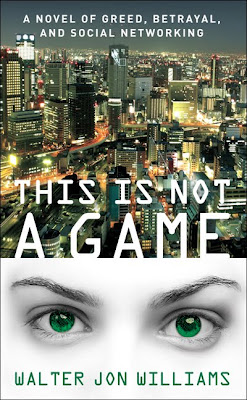
Book: Walter Jon Williams 'This Is Not A Game'
I grabbed this off the sci-fi paperback shelf at the library without really looking at it, because I was desperate and because the tagline on the cover is sort of cool ( 'a novel of greed, betrayal, and social networking'). This technique of reading-material-acquisition usually leads to me reading half of a boring book, getting bored, and giving it to someone else so they can become bored too. I actually made my dad, Mr. Scientific Guinea Pig, read this one first, because I was worried it would be too boring for me. He loved it! After I watched him rapidly turn pages while gleefully chortling for a couple of days, it became imperative that I read the book myself. I'm awfully glad I did, because it's awesome! The combination of ARGs, rampant gold-farming bots running amok, product-of-Caltech geeks who accidentally crash bits of the global economy, and also a handful of murders, makes for a most excellently thrilling read.
Special bonus: a lot of writers in the cyberpunk genre seem to find it impossible to write convincing female characters*. I think this is mostly because they sit down and try to write about a 'girl' as opposed to writing about a 'person,' and everyone knows that girls don't think or act anything like normal people do. Mr. Williams understands that gender is irrelevant to geekery; protagonist Dagmar, who is most definitely a geek, is a very believable girl character just because she thinks and acts like a geek rather than like a geek's idea of a girl. This is delightful.
* excepting the illustrious William Gibson, whose Bigend Trilogy is full of wonderfully lifelike ladies who bear a suspicious resemblance to human beings.
Special bonus: a lot of writers in the cyberpunk genre seem to find it impossible to write convincing female characters*. I think this is mostly because they sit down and try to write about a 'girl' as opposed to writing about a 'person,' and everyone knows that girls don't think or act anything like normal people do. Mr. Williams understands that gender is irrelevant to geekery; protagonist Dagmar, who is most definitely a geek, is a very believable girl character just because she thinks and acts like a geek rather than like a geek's idea of a girl. This is delightful.

* excepting the illustrious William Gibson, whose Bigend Trilogy is full of wonderfully lifelike ladies who bear a suspicious resemblance to human beings.
08 February 2012
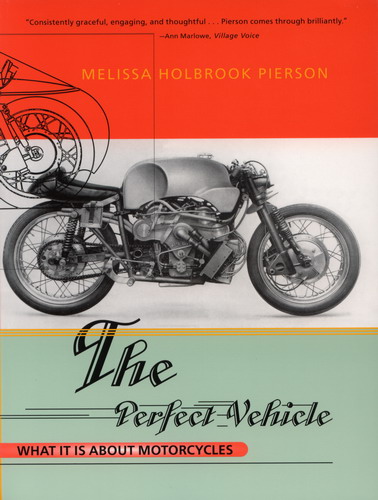
Book: Melissa Holbrook Pierson 'The Perfect Vehicle' (1997)
Reading this was an interesting experience. I found myself in the unusual position of liking the book immensely while disliking the author intensely. I could feel no sympathy towards her desperate need for a man to look after her, particularly as she described over and over again how she would entrust her beloved motorcycle to an inept mechanic, knowing that she'd end up redoing his work afterwards, just because she felt like she had to have someone masculine do those things for her. Sh*t like that irritates me insanely, particularly coming from a talented, reasonably successful woman who has ridden thousands and thousands of miles alone and is physically, though apparently not emotionally, capable of taking care of herself and her machines.
I can't dislike her book though, because this lady knows exactly how to describe what makes riding so wonderful. She's a damned fine writer, and manages the neat trick of writing nonfiction that's as much of a pleasure to read as a great novel. All of the tips and tricks and facts and bits of history are so neatly laced together with beautifully polished words that I almost wanted to memorize half the book, just because I knew I'd never be able to say these things so well in my own words. Any motorcycle aficionado ought to enjoy this book, which encapsulates much of the sheer joy of riding, and every non-rider ought to read it so they can better understand the rider mindset (and hopefully keep a better eye out for us when they drive their cars).

I can't dislike her book though, because this lady knows exactly how to describe what makes riding so wonderful. She's a damned fine writer, and manages the neat trick of writing nonfiction that's as much of a pleasure to read as a great novel. All of the tips and tricks and facts and bits of history are so neatly laced together with beautifully polished words that I almost wanted to memorize half the book, just because I knew I'd never be able to say these things so well in my own words. Any motorcycle aficionado ought to enjoy this book, which encapsulates much of the sheer joy of riding, and every non-rider ought to read it so they can better understand the rider mindset (and hopefully keep a better eye out for us when they drive their cars).
04 February 2012
Book: Neil Peart 'Ghost Rider' (2002)
This one's a bit of a tearjearker, the story of a man who lost absolutely everything and survived only by running away. It would be sad even if it weren't true - his daughter died, his wife died, his dog died, and his best friend went to prison - but it is true; all of that really happened to the author, who is also the drummer for Canadian band Rush. The book chronicles a series of impressively long motorcycle trips he took, through North and Central America, hoping that time, distance, and miles-put-behind would let him escape the shambles of his life. Apart from the tragic elements, it's a wonderful travel story; the collected letters and journal entries that he tied together with concise, illustrative reminiscences portray an astonishing number of km traveled, sights seen, and well-described fun roads ridden. He's a very good writer, in a concise, almost-journalistic sort of way. There is a little bit of a financial disconnect; as a reader accustomed to shoestring-budget travel, I did keep getting a bit hung up on all the expensive meals he ate and the way he could always afford to stay in good hotels, and his ever-growing collection of beautiful motorcycles. But hey - the man worked hard for his fortune, and I'm glad it was able to help him live through his troubles.
Highlight: one of the real pleasures of this book is reading about all the other books Peart, a voracious reader, consumed during his travels (I look forward to reading many of them myself).

Highlight: one of the real pleasures of this book is reading about all the other books Peart, a voracious reader, consumed during his travels (I look forward to reading many of them myself).

27 January 2012
Book: Daniel Silva 'Portrait of a Spy' (2011)
I think it's time for Mr. Silva to make good on his often-broken promise to let poor Gabriel Allon retire. Allon had a great run in his blood-and-paint-spattered career as mild-mannered art restorer by day, Israeli James Bond by night, but he has at last fallen prey to one of the hazards of being a long-running fictional character: he's become a formula. Portrait is book 11 in what has been a pretty good series of politically-based espionage thrillers. The first few were entertaining; the middle books were outstandingly good. Sadly, the later books seem mostly comprised of reworked bits from those excellent middle books.
The recipe: Gabriel and his beautiful young wife retire to Cornwall so he can paint in peace. An international terrorism crisis occurs. Gabriel says 'oh, yes, of course I will un-retire and save the world from the Arabs, but just this once. Again.' He and his team of super-spies come up with a dangerous plan to catch the terrorist leaders, which inevitably hinges on recruiting a beautiful woman who is rich, famous, or otherwise special. She bravely does her part, then gets captured and tortured. Gabriel kills a lot of bad guys, then sacrifices himself to save her. Then he goes back to Cornwall to recover, and swears he'll never spy/kill/save the world again. Until the next book.This one's a little different because the beautiful rich woman gets killed, but it turns out to be okay because she was dying anyhow.
Book 12 comes out later this year. I'll probably read it, out of morbid curiosity, habit, and the hope that something different will happen this time...

The recipe: Gabriel and his beautiful young wife retire to Cornwall so he can paint in peace. An international terrorism crisis occurs. Gabriel says 'oh, yes, of course I will un-retire and save the world from the Arabs, but just this once. Again.' He and his team of super-spies come up with a dangerous plan to catch the terrorist leaders, which inevitably hinges on recruiting a beautiful woman who is rich, famous, or otherwise special. She bravely does her part, then gets captured and tortured. Gabriel kills a lot of bad guys, then sacrifices himself to save her. Then he goes back to Cornwall to recover, and swears he'll never spy/kill/save the world again. Until the next book.This one's a little different because the beautiful rich woman gets killed, but it turns out to be okay because she was dying anyhow.
Book 12 comes out later this year. I'll probably read it, out of morbid curiosity, habit, and the hope that something different will happen this time...

04 January 2012
Book: Steve Earle 'I'll Never Get Out Of This World Alive' (2011)
Okay, I promise not to mention Steve Earle again for at least 10 posts. After this one, that is - Mr. Earle's debut novel has my vote for the best book of 2011, so I have to write about it. First of all, the man can write - anyone who pays attention to that sort of thing will be deeply satisfied by the style and grace with which he strings words together. Secondly, it's awfully rare that someone takes grim subject matter (in this case junk addicts, slums, whores, the Kennedy assassination, an accidentally-pregnant Mexican girl, and a discredited doctor turned back-alley abortionist who is haunted by the ghost of Hank Williams) and manages to create something which isn't depressing, disheartening, or just plain ugly. This book is so far from being ugly I think I'd have to label it something pretentious like transcendentally lovely, which, on second thought, doesn't seem excessive as a description for a story that travels from a Texas brothel to a Mexican valley full of Monarch butterflies. The book is named for Hank's last song, which you might like to listen to for context; there's also rather a good record of the same name which Earle released last year. I love, love, love this book - it's beautiful and heartbreaking and lyrical and sometimes funny, and also just a plain ol' good story - please, please read it.
 |
| What I originally wrote after reading this: 'I'm going to write a review once I can find the words, but in the meantime, please read this astonishingly beautiful little book. It will touch a corner of your heart that you might not even have known about.' |
22 December 2011
Book: Cherie Currie 'Neon Angel: A Memoir of a Runaway' (2010)
I really like this book. Cherie Currie, former lead singer of groundbreaking all-girl rock band The Runaways (whose founding and best-known member was the illustrious Joan Jett), has lived an extraordinary and varied life (from valley girl to underage rock star, film actress to nonfunctional drug addict, teen counselor to world-renowned chainsaw carver...), and her memoir spares none of the gritty details. It's a bit of a harrowing read, owing to the mind-boggling amount of illicit substances consumed, the heartless exploitation of talented young girls, and the sheer number of terrifying situations Ms. Currie managed to get herself into. It's also fairly amazing (and inspiring) to know how she lived through it all, reinventing herself over and over again, and continues to be a gifted, creative, and exceptionally strong lady. The quality of writing leaves a little to be desired, but I've seen worse, and the quality of content is more than satisfying.
Check out her website to see photos of her lovely and unique art.

Check out her website to see photos of her lovely and unique art.

11 December 2011
Book: Jeanette Winterson 'Sexing the Cherry' (1989)
I've labeled this piece a book, but I think it may really be a song
disguised as a sheaf of pages. It's funny - I've avoided reading it for
years, purely because I loathed the title - all that time I've been
missing out on one of the loveliest little novels I've ever experienced. Winterson's writing is as exotically musical as any of the finest compositions by Mozart and Hindemith, or
perhaps the gold-threaded concerti of Aram Khachaturian; as sensually,
synaesthetically pleasing as a night breeze, a glass of darkest china
tea, a sea of ragged-edged silks. An enchanted fairy-tale of sailing
ships, never-before-seen fruits from unmapped countries, twelve dancing
princesses, gardeners of kings, a giantess with a flock of hounds and
one far-reaching, roving, foundling son. Do read it; you couldn't
possibly regret doing so.


03 December 2011
Book: William Gibson 'Spook Country' (2007)
This is my new favourite book. I love Gibson's writing, which improves with every book, and I especially love the trilogy this is in the middle of (which starts with 'Pattern Recognition' and culminates in the glorious 'Zero History'). I loved this book so much I didn't read the last 6 pages for a whole week, because I couldn't bear for it to be over. It always impresses me how, 20 pages into a novel, he's got me caring about his characters, worrying about all the s*** he puts them through, and mentally begging him to give them a happy ending - which, mercifully, he nearly always does. Beautiful prose, touchable tasteable breathable atmosphere, intriguing plot. I rarely buy books, because the library's good at ordering things for me for free, but I bought this one so that I can read it until it falls apart and then buy another copy.
 |
| official website |
Subscribe to:
Posts (Atom)